

This Extremely Rare Chirodectes Maculatus Jellyfish Has Only Been Caught on Camera Once

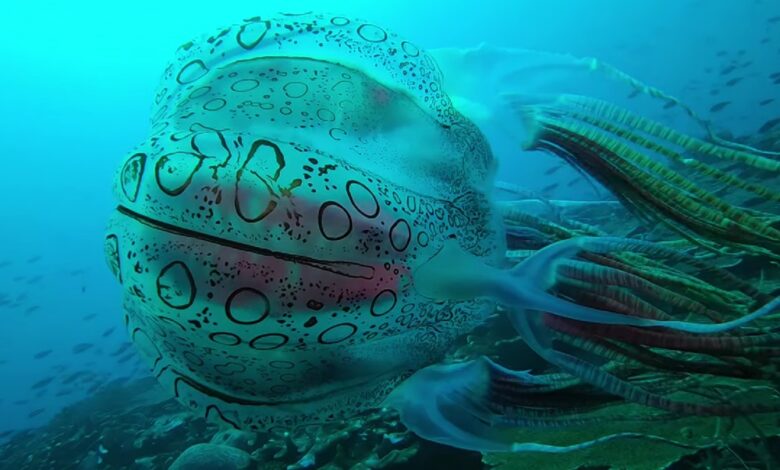
A diver off the coast of Papua New Guinea recorded a huge jellyfish “Chirodectes Maculatus” swimming alongside them, and posted the video to their Facebook page. They said the jellyfish was around soccer ball size, and swam “quite fast.”
Four groups of striped tentacles trail behind the jellyfish’s translucent body, which is spotted with rings of varying size. Inside the bell is a bright red organ that is most likely the animal’s gastrovascular cavity.
Chirodectes Maculatus Jelly Fish
This jellyfish is so rare that it only has two recorded sightings, ever. And this video is one of them.
It’s called Chirodectes maculatus (from the Latin for “spotted”), and it’s an extremely uncommon species of box jelly found off the coast of Queensland, Australia. Box jellies, distinguished for their boxy shape, are often venomous to humans—some are even potentially fatal. But C. maculatus isn’t known to be.
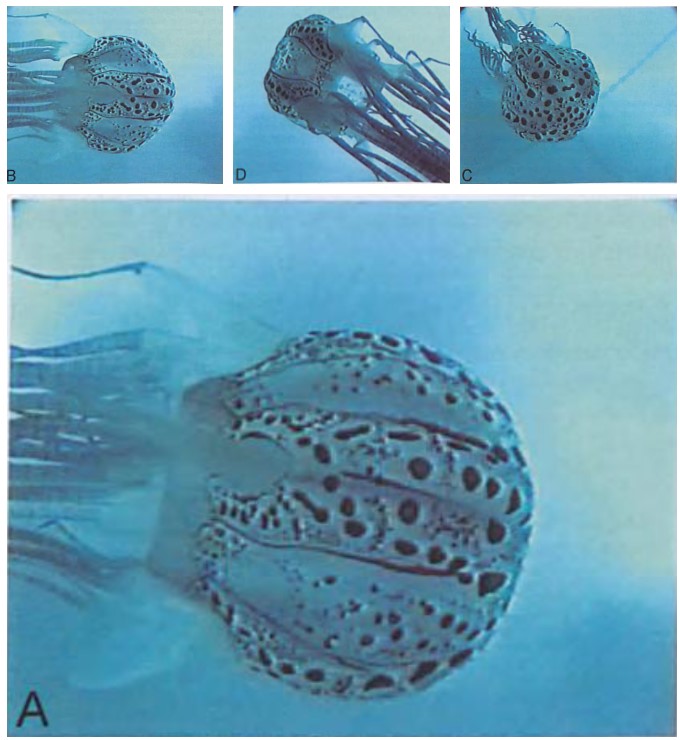
“It is not possible to make out all of the characters of the species Chirodectes maculatus from the video (some are internal), but it certainly fits very well based on what one can observe,” said Dr. Allen Collins, a zoologist and curator for the Smithsonian Institute National Museum of Natural History, in an email to Motherboard.
C. maculatus was first described in 2005, by a team of Australian scientists led by Paul Cornelius. They had caught the specimen in 1997 and preserved it. In the paper, they write that they were “reluctant” to dissect it, so they made only external observations. The scientists initially described the species as Chiropsalmus. A year later, another scientist, Lisa-Ann Gershwin, published comments on the organism’s classification, and officially moved it to the genus Chirodectes, where it was accepted.

Collins noted that the color pattern on the bell of the organism in the video was different from that described by the original scientists. The jellyfish from 2005 had solid spots, while the one in the video had rings. “I suppose there is always a chance that this specimen is from a closely related but as yet undescribed species of Chirodectes, but I would lean toward it being C. maculatus,” he said.
Collins said the video was striking because it was only the second sighting of the jellyfish, despite its size. “That something so large and conspicuous in appearance would only be seen twice is pretty surprising,” he said. “But that said, a lot of diversity is rare. It tells me that we still have a lot of exploration to undertake.”
The rare spotted box jellyfish (Chirodectes maculatus)
This huge jellyfish is known as Chirodectes maculatus, which means ‘spotted’ in Latin. It’s a type of box jellyfish, named so after its body shape.
They’ve got no fewer than 24 eyes of four different kinds. In 2011, scientists at the University of Copenhagen showed that at least four of these eyes always peer up out of the water, irrespective of the way the rest of the animal is orientated.
“Instead of having a single pair of general-purpose eyes like most other animals, box jellyfish have several different types of eyes used for special purposes,” said lead researcher Anders Garm of the University of Copenhagen.
“This means that each individual eye type is dedicated to support only a limited number of behaviors. The eyes can then be built to collect precisely the information needed, minimizing the need for further processing in a big brain. The automatic orientation of the upper lens eyes to constantly look through the water surface is a clear example of this.”
The size of a mature box jellyfish can vary depending on the species. On average, it can have a box-shaped body measuring up to 20 cm (8 inches) on each side, making it about 30 cm (12 inches) in diameter. Its tentacles, on the other hand, can extend up to an impressive length of 3 meters (10 feet). In terms of weight, it can reach up to 2 kilograms (4 and a half pounds).
Box jellyfish: some of the most venomous creatures in the world
Box jellies are famous for having tentacles covered in biological booby traps known as nematocysts — tiny darts loaded with venom. People and animals unfortunate enough to be injected with this venom may experience paralysis, cardiac arrest, and even death, all within a few minutes of being stung.
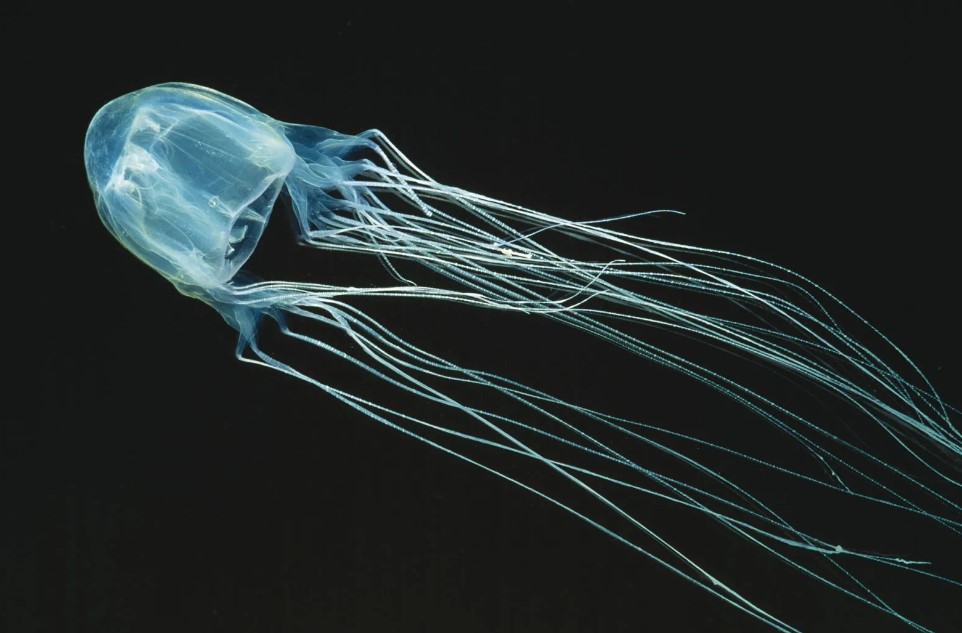
The Australian box jellyfish (Chironex fleckeri) is widely considered the most venomous marine animal in the world. This isn’t any ordinary venom but rather a sophisticated chemical cocktail designed for efficient predation and self-defense.
When contact is made, the venom takes effect almost instantly. It acts like a thief in the night, swiftly hijacking the victim’s nervous system. Suddenly, every signal your body sends is rerouted, causing unimaginable pain, heart complications, and, if left untreated, potentially even death.
Luckily, the rare Chirodectes maculatus doesn’t seem to be venomous, based on a 2005 study that described a specimen caught and preserved 25 years ago. Initially, this study classified the box jelly as Chiropsalmus, but it was later moved to the genus Chirodectes following other considerations by the scientific community, according to Vice.
“That something so large and conspicuous in appearance would only be seen twice is pretty surprising,” Dr. Allen Collins, a zoologist and curator for the Smithsonian Institute National Museum of Natural History, told Vice Motherboard. “But that said, a lot of diversity is rare. It tells me that we still have a lot of exploration to undertake.”
This is a reminder that there’s much about life in the oceans we still haven’t discovered yet. Who knows what we’ll uncover next?