


Man’s inhumanity to man. It is quite astonishing how some humans would go through any means necessary to erase or get rid of their fellow human beings. Due to hatred or to show superiority.
Throughout the centuries there have been different inhumane methods of execution used across the world. One example was trapping a victim in a small box and leaving him or her inside to die of starvation.
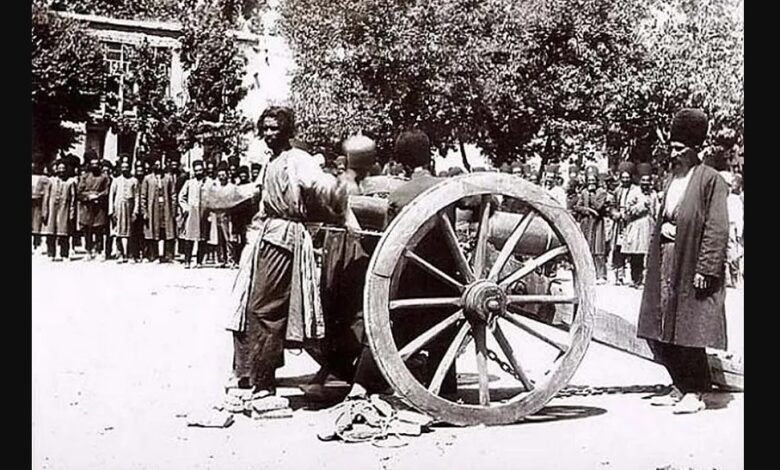
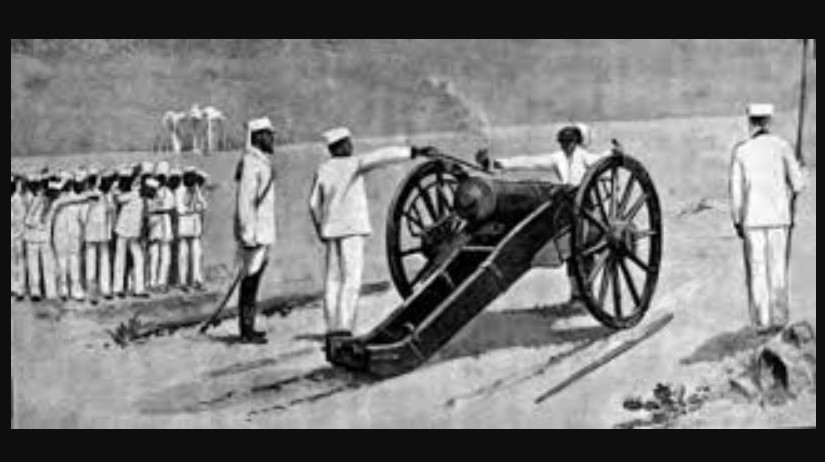
The photograph above shows an Iranian convict whose name is unknown, placed with his back in front of the mouth of a cannon. This was done in the 1890s and in a few moments, his body will be scattered to bits.
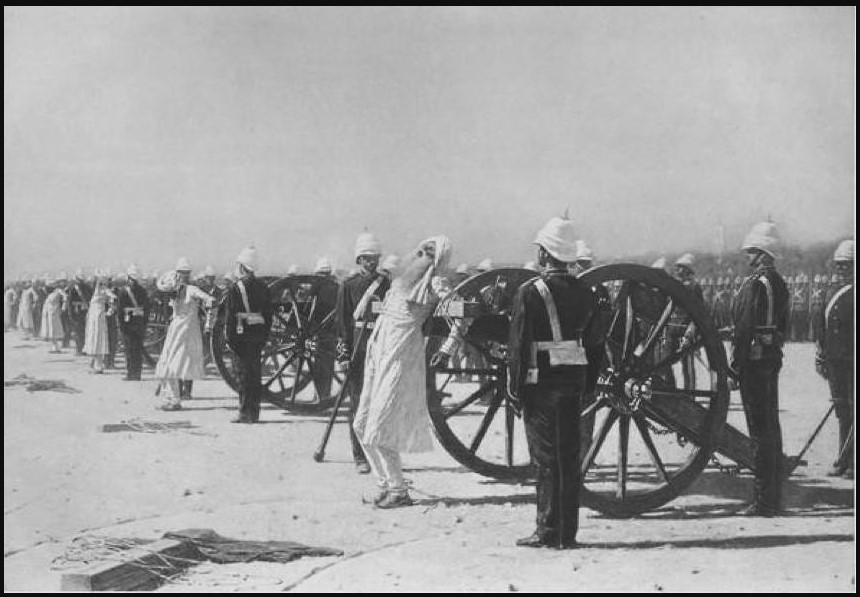
Blowing from a cannon has been used as a method of execution since the 16th century and even during the 20th century. It is a method of execution in which the victim is typically tied to the mouth of a cannon which is then fired, resulting in death.
It is believed that blowing people from the cannon as a method of execution was an “old Mughal punishment” on the Indian subcontinent. The Mughal Empire used this method of execution during rebellions and as punishment for a variety of crimes.
During a siege in 1719, the problem of deserters was eventually solved for the commander of the Mughal army by blowing four deserters caught in the act from cannons, in the presence of his troops.
The method was used as a form of capital punishment by Portuguese colonialists in many of their colonies in the 16th and 17th centuries. An account stated that a Portuguese explorer name Francisco de Almeida is reported to have blown many individuals from cannons in Sri Lanka, around 1509. Another states that during the Dutch siege of Colombo in 1656, the city population endured extreme famine.
One nursing mother became so starved that her production of milk stopped, and her infant was dying. She chose to kill it, and eat it. Once the Portuguese general became aware of her act of cannibalism, he ordered her blown with a gun, but in this particular instance, the clergy and the principal citizens dissuaded him from carrying out the act.
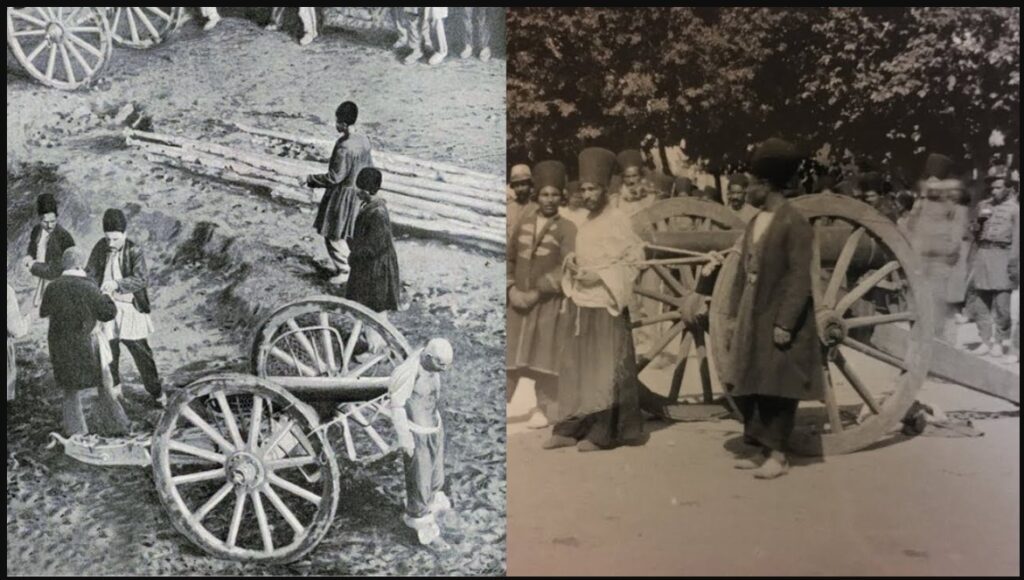
The method was also used by the Portuguese on the people of Mozambique and Brazil. In one account 50 Muslim individuals in Mozambique were either “impaled, blown from mortars, torn apart on tree-trunks, axed or shot”. In Brazil in 1618, indigenous resistance against the Portuguese was unshaken, although a leader of them, Amaro, was taken prisoner and blown by a cannon.
Arguably, the nation most well-known to have implemented this type of execution was the British Empire. In its role as the paramount power in India, the British used this form of execution as a punishment for native soldiers found guilty of mutiny or desertion.
In March 1764, a native officer secretly planned to persuade the men under his command to defect to an enemy force. But unfortunately for him, his plan was discovered and he was blown from a cannon in front of his soldiers.
But in 1798, a mutiny broke out among the British soldiers. One of the soldiers was condemned to be blown from a cannon. This is the only account of an European to have been blown from a cannon by the British.
This method of execution was also used alongside other capital punishments such as flogging (to death) and these punishments were shown to those who were summoned to watch in other to deter them from repeating such crimes.
In 1806, the Vellore Mutiny began with many British soldiers and officers being killed in their sleep. Six mutineers were sentenced to be blown from the cannons. Further plots to exterminate all Europeans were discovered and further use of this method of execution was ordered.
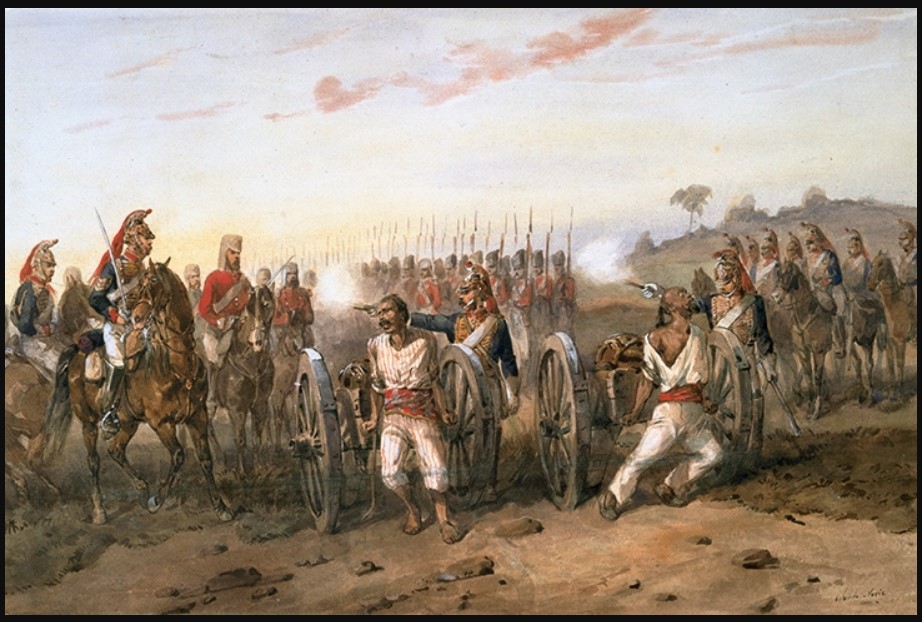
It was in 1857, During The Great Rebellion that this method of execution was used the most to suppress the Indian Rebellions. According to a journal it is reported that:
On 8 June, two sepoys from the 35th light Infantry were blown from guns. 10 June, in Ludhiana, Peshawar, some 40 from the 54th regiment were blown from guns. On 13 June, ten sepoys from the 45th Regiment at Firozpur were blown from guns, two hanged. The same day, in Ambala, 10 sepoys from the 54th regiment suffered the same fate. The 26th of the same month, in Aurangabad, 1 was blown from a gun, 1 hanged, and 3 were shot. On 8 July, in Jhelum, it is assumed that captured rebels would be blown away. On the 19th, Aurangabad, 1 was blown away, 2 shot. On 5 September, Settara, 6 were blown away. On 17 September, Multan, 1 was blown away, and 121 were summarily executed. On 23 September, in Karachi, 1 was blown away, 7 were hanged and 20 deported. (The local body count on court-martialed individuals then came to 4 blown away, 14 hanged, 22 deported and 3 beheadings.) At the end of October, in Rohilkhand near Agra, 1 was blown away. On 16 November, Bombay, two sepoys from the 10th regiment were blown away.
It was said that in a few months between May and September 1857, 523 were recorded executed in India and 44 of them were blown from a cannon.
The use of this method did not stop in 1857. In 1871, 65 members of the Sikh sect Kukas or Namdhari were executed by the British, by being blown from cannons.
In Afghanistan, Blowing from cannons was used as early as the nineteenth century up to 1930. It was used in the late 1920s to destroy political opponents.
Problems with this method of execution
Using this method didn’t always work according to plan. On one account, there was a mass execution at Firozpur in 1857, there was an order that blank cartridges should be used, but some cannons were loaded with grapeshot instead.
This resulted in a number of the spectators facing the cannons to be hit by the grapeshot and some had to have limbs amputated as a result. In addition, some of the soldiers had not been withdrawn properly and sustained injuries from being hit by pieces of flesh and bones.
In another account, a soldier who was to be shot managed to fall just as the shot went off, with the following result: “One wretched fellow slipped from the rope by which he was tied to the guns just before the explosion, and his arm was nearly set on fire. While hanging in his agony under the gun, a sergeant applied a pistol to his head; and three times the cap snapped, the man each time wincing from the expected shot. At last, a rifle was fired into the back of his head, and the blood poured out of the nose and mouth like water from a briskly handled pump. This was the most horrible sight of all. I have seen death in all its forms, but never anything to equal this man’s end.”
It was also reported that birds of prey would circle above the execution place and dive down to catch pieces of human flesh in the air, and loitering dogs would rush to the scene to devour some of the body pieces spread around.
This is by far one of the most brutal methods of execution ever imagined. It is so inhuman for one to carry out this form of execution on other human beings all in the name of superiority and sending a brutal message to those who are being colonized to fall in line or face the inhuman consequences.
This is just a clear picture of what Man’s Inhumanity To Man looks like.